At a glance · Southern Quadrant
Article contents
Antarctica or Southern Quadrant Siege Capital (SQSC)[2] is divided into three parts: West Antarctica, East Antarctica, and the Antarctic Center.[3]
Parts
| Name | Details |
|---|---|
| West Antarctica | |
| East Antarctica | |
| Antarctic Center |
Locations
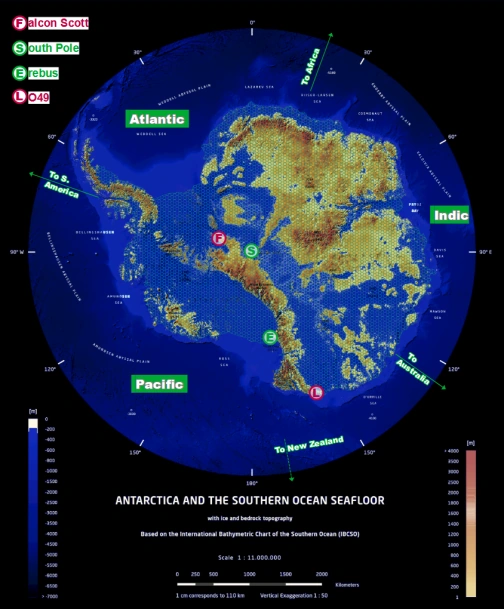
Antarctic Center
| Locations | Details |
|---|---|
| Coastal Highway | The highway was wide, flat, kept in good condition, and stretched most of the way to the very northern edge of the Antarctic Center as it skirted the whole landmass between the mountains and the ocean.[6] The route was broad enough for ten Rhino-sized APCs to drive side by side, but it was blocked from the main thoroughfare by a heavy barrier. A railway stretched north and south behind it, closer to the mountain slopes, meant for transporting armored trains over the landmass. The other side of it was close to the ocean.[7] |
| Falcon Scott | It is the northernmost city in Antarctic Center and the first and largest siege capital in the Antarctic Center, located close to the water.[8] |
| Erebus Field | From the Coastal Highway, one must turn inland and scale the mountains to reach Erebus Field. It is one of Antarctica's most prominent cities and is well-known for its geothermal energy farms, fertile land, and warmth.[8] |
| LO49 | It is a very important research installation located at the southernmost point of Antarctica.[9] |
| Unnamed Siege Capital | It is located about three hundred kilometers northeast of Erebus Field, over the mountains.[10] |
East Antarctica
East Antarctica was significantly larger than the Antarctic Center in terms of territory and population, with a more varied landscape featuring vast plains, long mountain chains, and numerous lakes that ranged from relatively small to those that were as large as seas. Twenty-one siege capitals face Nightmare Creatures, each protecting around nine hundred million people.[12]
| Locations | Details |
|---|---|
| Seventeenth Evacuation Corridor (Corridor Seventeen) |
Corridor Seventeen connects one of the largest siege capitals in the region to the coastal fortress. It is vital for evacuation efforts.[13] |
Background
- Main article: Waking World § Before Nightmare Spell
Before the Dark Times, Antarctica was covered in ice. The melting of all its ice was one of the reasons that caused the Dark Times.[16]
Trivia
- The Antarctic Center was a long, narrow, mountainous landmass that served as the continent's administrative and industrial center. As a result, it housed a number of high-priority targets that had to be evacuated at all costs.[4]
- In early April, Antarctica experienced perpetual twilight with the sun staying in place painting a vibrant scarlet horizon. The Southern Quadrant was slipping into darkness. The moon was behaving oddly. It stayed in the sky for weeks and disappeared for stretches, often accompanied by Aurora Australis.[17]
- Many of the old tunnels went through several rounds of additional excavation to serve as bomb shelters during the latter stages of the war between unknown sides.[18]
- Antarctica was the first region to fall and was most likely fully absorbed by the Dream Realm, with most of it transported somewhere beyond the Burned Forest, becoming an open wound in the flesh of Earth that unleashes an endless flood of Nightmare Creatures.[19]
See Also
References
- ↑ Chapter 903 Abstract Numbers
- ↑ Chapter 1699 First Impressions
- ↑ 3.0 3.1 3.2 3.3 3.4 3.5 3.6 Chapter 816 Three Phases
- ↑ 4.0 4.1 Chapter 843 Falcon Scott
- ↑ Chapter 875 Old Roads
- ↑ Chapter 946 Scenic Route
- ↑ Chapter 947 Highway to Hell
- ↑ 8.0 8.1 Chapter 960 Erebus Field
- ↑ Chapter 874 One Last Mission
- ↑ 10.0 10.1 Chapter 961 Sand Castles
- ↑ Chapter 967 Smooth Ride
- ↑ Chapter 1064 East Antarctica
- ↑ Chapter 1078 Army Scout
- ↑ Chapter 1081 Lake Ruin
- ↑ Chapter 1082 Ancient Chimneys
- ↑ Chapter 754 History Lesson
- ↑ Chapter 845 Ranged Specialists
- ↑ Chapter 931 Rival of Light
- ↑ Chapter 3206 Bad Weather
Sources & history
Southern Quadrant · Shadow Slave Wiki
Source revision 44108
Adapted from Fandom. CC-BY-SA
Images: sources & credits
- Antarctica.png
Retrieved 2026-11-04 · Article version 1